19

Given an image or animation of a body in space, the learner identifies it as a moon when (and only when) it orbits a planet, distinguishing it correctly from inner planets (1-feature minimum-difference partner), comets, asteroids, and outer planets.

grade level
5
frames
17
  1. 01A moon is a body in space that orbits a planet. Let's look at Earth's Moon. It travels in a path, or orbit, around the Earth. Because it orbits a planet, we call it a moon.
  2. 02Moons can be small and oddly shaped. This is Phobos. It is a small, rocky body, but it orbits the planet Mars. Since it orbits a planet, we classify Phobos as a moon.
  3. 03Moons can also be huge and covered in ice. This is Ganymede. It orbits the giant planet Jupiter. The size or shape of the body does not matter to us. Because we see that it orbits a planet, we know Ganymede is a moon.
  4. 04Let's compare that to an inner planet like Mercury. Mercury is a round, rocky body, but it orbits the Sun, not a planet. Because it does not orbit a planet, we know Mercury is not a moon.
  5. 05This is Halley's Comet. It is a chunk of ice and dust flying through space. It orbits the Sun, just like the inner planets do. Since it orbits the Sun and not a planet, we know Halley's Comet is not a moon.
  6. 06This is the asteroid Vesta. It is a rocky, irregular body floating in space, but it also orbits the Sun. Because its orbit goes around the Sun instead of a planet, you can see that Vesta is not a moon.
  7. 07Let's look at Earth's Moon orbiting the Earth. Is Earth's Moon a moon, and why?
  8. 08Let's look at Phobos orbiting the planet Mars. Is Phobos a moon, and why?
  9. 09Here is Earth's Moon again, traveling in its orbit. How do you classify it, and why?
  10. 10This is the inner planet Mercury, orbiting the Sun. How do you classify Mercury, and why?
  11. 11This is Phobos, a small body orbiting Mars. How do we classify Phobos, and why?
  12. 12This is Halley's Comet, moving along its long orbit around the Sun. How do you classify Halley's Comet, and why?
  13. 13This is Ganymede, a massive icy body orbiting Jupiter. How do we classify Ganymede, and why?
  14. 14This is the asteroid Vesta, orbiting the Sun in the asteroid belt. How do you classify Vesta, and why?
  15. 15This is Titan, a large body with a thick atmosphere orbiting Saturn. How do we classify Titan, and why?
  16. 16This is the outer planet Jupiter, orbiting the Sun. How do you classify Jupiter, and why?
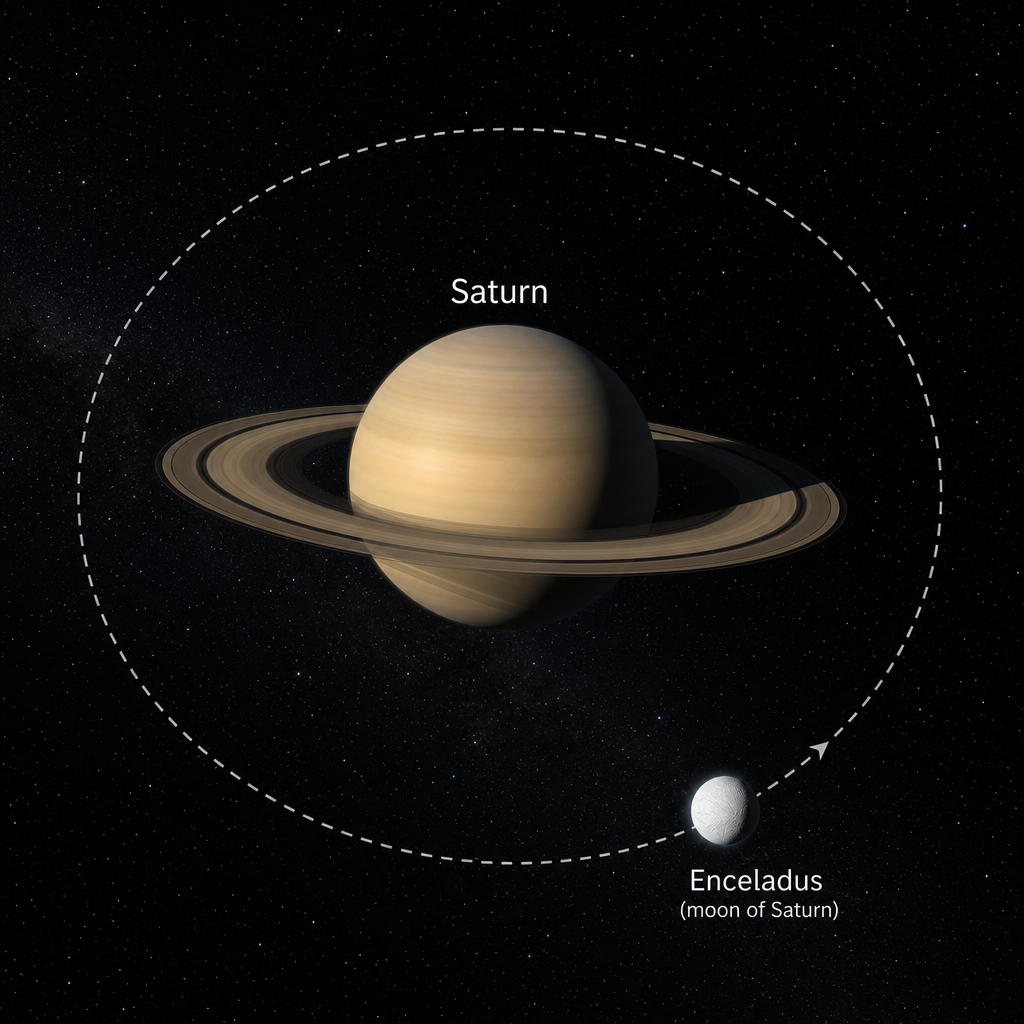
  17. 17This is Enceladus, a bright icy body that orbits Saturn. How do we classify Enceladus, and why?
You can see the ringed planet Saturn with a dotted circular path around it. A bright, icy, white spherical body named Enceladus is traveling on the path. You can clearly see Enceladus orbiting a planet, which defines it as a moon despite its icy surface.

Prompt

This is Enceladus, a bright icy body that orbits Saturn. How do we classify Enceladus, and why?