03
Given a paired view of a star at varying distance from the observer, the learner answers in two parts: Q1 'How does this star look — disk or point?' (correct response: 'a disk' when close, 'a point' when far) and Q2 'Why?' (correct response: 'because it is close' / 'because it is far'). The learner applies the rule across multiple stars (the Sun and Proxima Centauri) and accepts that the same body looks like a disk OR a point depending on distance.
- grade level
- 5
- frames
- 18
This happens because Earth is very close to the Sun. Any star that is close to you will look like a disk.
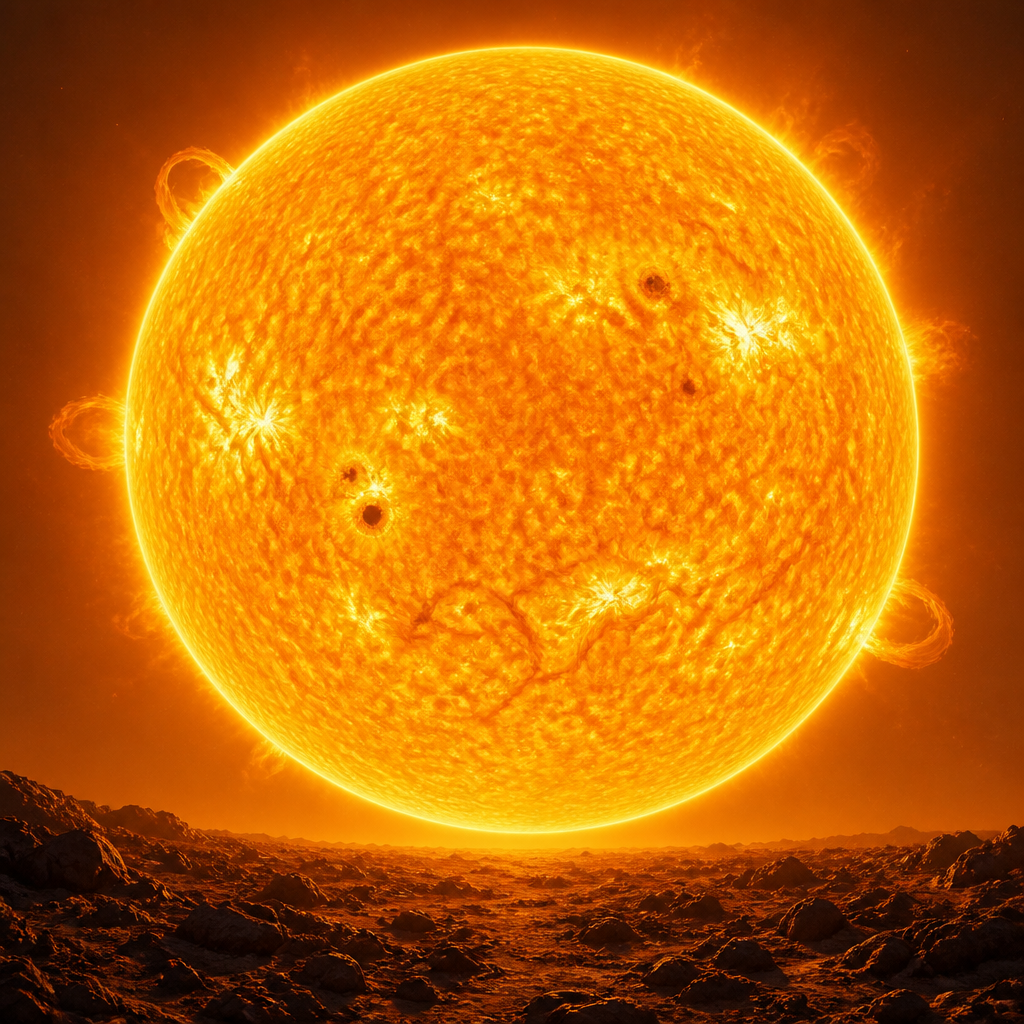
The Sun appears as a massive, brilliantly glowing circle with distinct visible features and a clear boundary in the sky. This round shape is called a disk, and it shows exactly how any star looks when you are located very close to it.